
OPENING QUESTIONS:
Consider the following displacements:
You travel 15.0 meters at a 35 degree angle (to the horizontal)
- Sketch that vector
- What was the x component of your motion?
- What was the y component of your motion?
Now let's say after completing that motion you traveled 19.3 meters at an angle of 137 degrees to the horizontal.
- Sketch that vector
- What was the x component of your motion?
- What was the y component of your motion?
Let's say that you new in advance what your two vectors of travel are going to be. Discuss with your group how you might compute your final destination before you even begin your travels.
═══════════════════════════
LEARNING OBJECTIVE:.
I will be able to determine the time at which a projectile reaches it's highest point after today's class.
I will be able to determine the range at which a projectile travels after today's class.
I will be able to sketch the vectors for the x component and y component of velocity for a projectile after today's class.
WORDS FOR TODAY:
- DISPLACEMENT (distance & direction)
- Distance
- VELOCITY (speed & direction or change in displacement/change in time)
- Speed (change in distance/change in time)
- INSTANTANEOUS VELOCITY (dx/dt)
- ACCELERATION (change in velocity/change in time, dv/dt)
- Derivative (the instantaneous slope of a line/curve at a given point)
- Integral (the area 'beneath' a line or curve)
CALENDAR:
- Kinematics Test (1 d and 2 d) on Thursday
- TP Lab due on Friday
WORK O' THE DAY:
MONDAY Conversations: Stress
By the by, did anyone start working on your lab yet?
- Do you have questions about error in measurement?
- Error propagation?
- Final Error?
Oddly enough there is a substantial source of error that we haven't discussed.... Hopefully that will come out in your deliberations with your group as you work on the lab.
═══════════════════════════
Introducing motion in 2 dimensions
Consider the drawing below. Please digest the following graphic with your group.

Now imagine you had your trusty-dusty wrist-rocket:
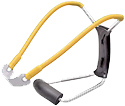 |
slingshot loaded with a 3/8" steal ball bearing.
Let's say you launch that projectile at 41 m/s (about 92 mph):
- Find Viy
- How long will it take that ballbearing to reach hmax?
- Find hmax?
- Find total flight time for the ballbearing.
- Find vix
Find xmax
═══════════════════════════
Now let's compare that to one of the largest projectiles ever fired during battle--
Now let's say that the initial conditions for that launch were similar to a 16" battleship gun projectile:
1) Velocityi = 762 meters/second (according to wikipedia)... remember, velocity is a VECTOR so we MUST include a direction. In this case, let's say the original launch angle is 40.0 degrees to the horizontal.
Draw a vector diagram showing those initial conditions
1) Now calculate the x component of that velocity
2) Now calculate the y component of that velocity
3) Now calculate the maximum length of time that shell can stay airborne and the maximum height it reaches (assuming that both launch and strike areas were the same elevation, disregard air friction, wind speeds and the curvature of the Earth)
4) Now calculate how far from the battleship the shell lands.
5) Now please use your chromie to find out how far the projectile actually went....Please work with your group to conduct an analysis to suggest (in appropriate scientific terms) reasons why there is such a profound difference between the calculated and actually down-range flight of that projectile.
═══════════════════════════
Answers (NOTE, please check my math... because the numbers I get DO NOT square with the purported range given in the wikipedia article, but the again, that's why we are ALWAYS cautious with wikipedia data):
1) the x component of velocity is vicos(θ):
(762 m/s)(cos40) = 583 m/s
2) the y component of velocity is visin(θ):
(762 m/s)(sin40) = 490 m/s
3) we use two of our main equations of motion. First let's find the height this projectile goes:
vf,y2 - vi,y2 = 2ay
Noting that the final velocity is zero and rearranging variables so that y is on one side we get:
-vi,y2/2a = y
Now solving for y (and noting that a = acc of gravity DOWNWARD which we assign to be negative):
(-490 m/s)2/(2)(-9.81 m/s2) = y = 12,200 (sig figs) meters (that seems fairly massive, ~ 8 miles high... please check my math!!)
Now let's find how long it takes to get that high (noting that vf = 0 m/s):
vf,y = vi,y + at
and rearranging terms:
vi,y/a = t => (-490 m/s)/(-9.81 m/s2) = 49.9 seconds!!!.
Note, however that is just the time for the projectile to go UP, so we have to double that time to account for flight time back down to Earth: (49.9 s)(2) = 100. s (sig figs)
4) after doing all that work we have a very simple calculation for motion in the x direction. Remember, x motion is constant so we use middle school math to solve for rate x time = distance:
(vi,x)(time) = displacement
Now let's plug and chug using our value for velocity in the x direction we found out way, way earlier in this problem and the time the projectile will remain aloft (that we just found in part 3 above):
(628 m/s) (100. s) = 62,800 meters which is just over 40 miles (which is twice what the same wikipedia article claims the range of the guns to be so SOMETHING is fishy)
However, this site (which looks FAR more authoritative confirms the maximum range of a mark 7 battleship shell weight 2700 lbs to be 36,900 yards ~21 miles)
SOOOOOO.... why is our calculation (which I THINK I did right) soooo far off the actual value?
Answers:
- Air Friction
- Temperature & Humidity (goes to air density)
- Curvature of the Earth
HOMEWORK:
- Please review worked problems:
- Please take a swing at O problem:
- And then C problem:
- And problem #: